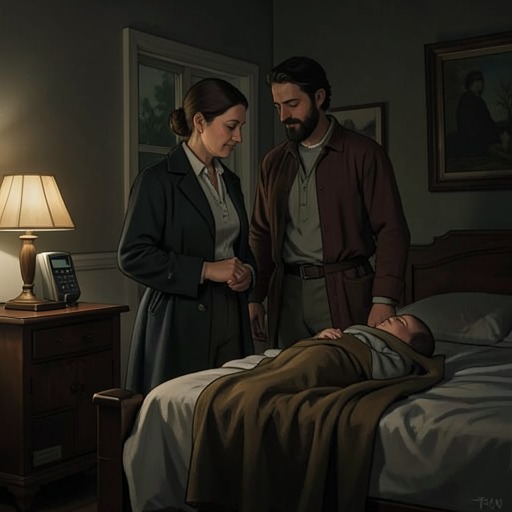
Amaia Salazar—James: marriage and partnership
Legado en los huesosAmaia Salazar and James’s marriage is a partnership of tenderness and practical care, tested by childbirth, demanding work, and the uneven pressures of caring for a newborn. Their affection is unmistakable, but the novel also shows how love can coexist with exhaustion: James offers support, while Amaia struggles to make her needs understood and to reconcile motherhood with a painful history of her own.
A domestic partnership
James’s care appears in small, physical gestures. When Amaia arrives at the restaurant, he rises, kisses her, and draws out her chair. He has chosen a modern restaurant near their home on Mercaderes Street, where they have settled into eating every meal out. Clarice disapproves of James cooking daily and hints that they should have domestic help; the arrangement lets the couple avoid the prospect of returning home to find that she has installed an English butler. Their shared household is therefore affectionate but not sealed off from family interference: Clarice and the quiet Thomas are already at the table when Amaia arrives.
At the meal, James asks about the baby and puts a hand on Amaia’s pregnant belly. Amaia considers telling him that her contractions have begun, then decides against it while looking at Clarice. The moment shows both intimacy and restraint. James’s attention is on his wife and their child, but Amaia withholds what is happening, concerned that Clarice will become hysterical. Later, she explains that the contractions are not very painful, more like intense pressure, and asks for calm while she monitors their frequency and waits until it is time to go to the hospital.
That night, James initially resists going to bed, but Amaia persuades him to rest so that he will be awake when she needs him. He sleeps sprawled across more than his fair share of the bed, with the ease she has long envied. Their exchange over whether she will be all right is an ordinary act of reassurance made consequential by the approaching birth: Amaia takes charge of timing and tells him she will call him when the moment comes, while he trusts her assessment and prepares to be useful when needed.
Birth and shared tenderness
When their son is born, James reaches out to touch the baby’s cheek. His voice breaks as he tells Amaia how wonderful the child is, and tears run down his face. He bends to kiss her; she congratulates him too, addressing him as the baby’s father. The scene presents the birth as an experience they share rather than a trial Amaia endures alone. James’s emotion is visible, and the exchange joins the new child to their marriage through mutual congratulations and touch.
Parenthood under strain
After the birth, their closeness is harder to sustain amid the demands of work and infant care. James takes the sleeping Ibai from Amaia’s arms and lays him down, covering him to the waist with a blanket. He tells Amaia that he misses her. For a moment, their eyes meet and she nearly runs into the embrace that has become a defining sign of their union, mutual care, and the refuge she has found with him. The impulse is real, but so is her frustration: she is tired, has not eaten, has come from an autopsy, and must hurry across the city while barely getting time with her son—or for herself.
Amaia resents James’s mournful manner because it does not relieve the pressure she is carrying. She recognizes that he is kind, a good father, and exceptionally understanding, yet feels that he cannot grasp what her experience is like. Her anger is followed by the knowledge that she is being unfair; she leaves the room irritated with him and with herself, then makes coffee while avoiding his gaze. The scene does not turn a temporary rupture into a failure of the marriage. Instead, it shows how mutual affection can be present even when one partner’s needs remain difficult to express and the other’s sympathy misses its mark.
The same strain shapes their conversation about breastfeeding. James cautiously suggests that the demands of continuing to nurse may not fit with Amaia’s work and that she might seriously consider switching Ibai to a bottle. The proposal is framed as a practical concern about her schedule, not as a lack of care for the baby. Amaia, however, cannot hear it as merely logistical. She wants to do motherhood well for Ibai and for herself, and fears that any failure would make her a bad mother like her own mother. The question opens into a deeper crisis: she wonders whether her frustration means something is wrong, and why she feels exhaustion and failure instead of the happiness and fulfillment promised by books about motherhood.
Family history and the meaning of care
Amaia’s anxiety is rooted in a childhood shaped by Rosario’s abuse and by the adults’ failure to protect her. In a conversation with Ros, Amaia learns that Rosario once mistook her sister for Amaia and threatened the child in a chilling way. Ros had returned to Amaia’s bed afterward, frightened, and had kept the memory secret. Amaia tells her sister that the responsibility belonged to their father, who should have defended her; instead, he protected Rosario and sent nine-year-old Amaia away from home. This history clarifies why being a mother carries more than the ordinary demands of care for Amaia: she is afraid that frustration might mean she is becoming the person who hurt her.
A further family secret surfaces when Amaia hears that Rosario said one baby had been stillborn but concealed that there had been another girl. Amaia’s immediate shock makes the past of childbirth part of the present’s emotional landscape. The available scenes do not show James responding to these revelations, so their importance to the marriage lies in the pressure they illuminate within Amaia, not in an unrecorded reaction from him. Against that inherited fear, the marriage’s recurring gestures—James’s kiss, his hand on her belly, his care for Ibai, and the embrace Amaia longs for—offer evidence of a different pattern of intimate care, even as they cannot by themselves dissolve her exhaustion or trauma.